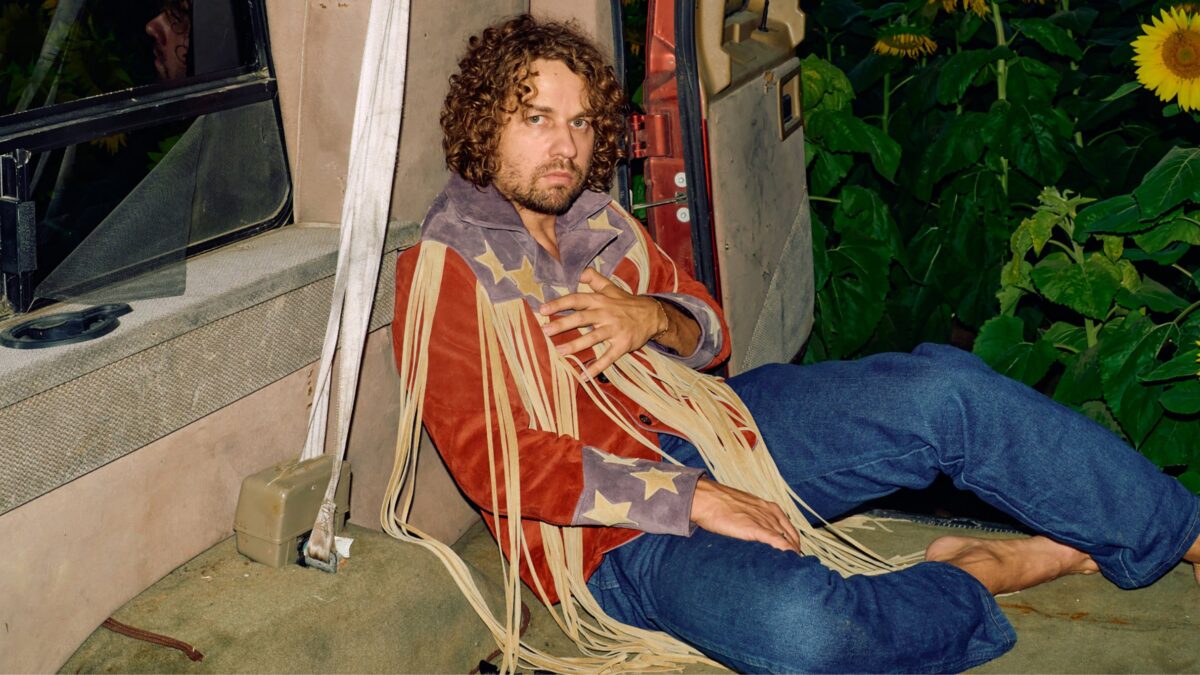
Kevin Morby
Liam Kazar
Fri, June 12, 2026
Doors: 6:30 pm
Show: 8:00 pm
lincoln theatre
Washington, DC
Kevin Morby has partnered with PLUS1 so that $1 from every ticket sold on our tour will go towards organizations protecting immigrant rights and safety.
Any tickets suspected of being purchased for the sole purpose of reselling can be cancelled at the discretion of Lincoln Theatre / Ticketmaster, and buyers may be denied future ticket purchases for I.M.P. shows. Opening acts, door times, and set times are always subject to change.
Kevin Morby
You want to shine for friends when they’re shining—for you or maybe not for you, either way
shine is shine—and you can equalize the levels by bringing a bit of your own recent glow, and
that other light-filled person can enjoy it instead of worry.
That’s how it is with some people. Two auras, touching, as you each bring your way of worlding
into the bar or the diner or the movies, the car, like so. See Morby, Kevin, in the Encyclopedia
Britannica of Glow, or Who’s Who in America and Outside of It That Moves Me, published by No
One Ever, but indelibly print-on-demand.
Last time I saw Morby there was a gash on the driver’s side rear quarter-panel of his big blue
truck. “What’s up with that?” A happy shrug. “Looks like I use it.” He does use it. I was in the cab
practically yesterday in Kansas City and now we’re West. He parks on my street. We go down a
secret stairwell and along a brutal stretch of Sunset. “This will never gentrify,” I say, “because
the cars here go seventy.” “It already is,” he replies, as we pass a natural wine shop or whatever
they’re selling, spare shelves and a tote bag logo. But it’s mostly nuclear fall-out, the underside
of a rich city, trash and weeds and plundered copper, before we turn left up to what I call
Peacock Park. Kevin’s never been. It’s dusk. We sit like kings, like Mickey in the Night Kitchen,
perched over the storybook up-close downtown skyline. I’m ready to practically camp out when
Kevin says, Let’s go. Next is Astro Family. Him, a burger and fries. Me, omelet. Pacifico; Stella.
Kevin poses with the Heinz bottle, and we agree that “I like ketchup on my ketchup” is a T-shirt
in the category of Pop sublime. “Haruki Murakami wears one,” he says. (I can hear a baby
crying on this part of the tape. Next over orange vinyl booth. I like ketchup on my ketchup. I like
babies in the booths.)
Our beers come in chilled steins. “I’d be into having a fridge full of these,” Kevin says. But he
does not strike me as someone who lives for beer, and he seems to be leaving behind the
midwestern concept of the den, the wet bar, the basement pool table, Miller Lite pendant lamp.
Or maybe not. But he’s leaving Kansas, is the point, and this record is about it. Before our
hangout I googled “little wide open” to see if there’s something besides my sense of this phrase,
which is that if once the future was legible, it’s now a bit less predictable. It’s a little wide open.
But to some this phrase means lit, as in drunk. News to Kevin. For him, the LWO is the big sky,
the small lives—it’s his origins in the Midwest and every duty and modesty and familiarity and
isolation: the land, the people, and the parts of that inside him. “I love the little wide open,” he
tells me, “and I hate the little wide open.” Cities of a hundred thousand people. Places where
girls twirl batons. Hearing those lines, “pretty girls, pretty sisters, twirling batons, blowing penny
whistles,” I think immediately—as would you—about the story of Terrance Malick asking Sissy
Spacek if she had any special talents. Baton, she said, and twirled one in the movie. But Kevin’s
song Badlands isn’t exactly about the Malick. “Kansas City is not the badlands but it’s my
badlands. It’s not the bible belt but it’s my bible belt.” The song “Bible Belt” alludes to something
that happened in 2021, when Kevin was on tour and got word that a couple, a boy and a girl
who were on their way to see him play in Denver had a car wreck and the boy died. The girl
lived, and while she was in the hospital, Kevin sent her a message. A year later he played at the
Bataclan, in Paris, which naturally made him think of what had happened there, ninety shot
dead in a terrorist attack. Onstage, he looked down, and there was the girl who had survived the
car wreck in Denver. She was with the mother of her boyfriend who died. They had come all this
way to see Kevin play. He recognized them immediately. “Do you have priestly instincts to rise
to the moment and be what people need?” “Sure. But everyone goes into a show with a
preconceived idea of how it’s gonna go. Whether it’s, I want to drink beer and rock out. Or ….
That. It broke the ice for me. The Bataclan felt like hallowed ground. It was very very sweet to
see them.” We shift to talking about time. The record isn’t just about leaving. It isn’t just about
Katie (there are more love songs here than usual, I tell him, and he concurs). It’s about time,
about feeling like he has shifted from nostalgia, and the losing game—losing but beautiful—of
holding onto the past. He has accepted that time is ceaselessly flowing, and you can’t stop it.
Instead, he feels like he’s riding it. He’s riding passenger with time. They’re doing it together,
shooting forward in tandem, Bonnie and Clyde. I ask him about that line, “I’ll ride passenger in a
burlap sack,” it’s more than at peace, and passive. It’s, I’ll risk everything, and could end up
dead. That’s what I hear. I started rambling about a memoir I just read by a musician I once
knew, a guitar player who was in the band Tuxedomoon. Every story in his book was about how
fate intervened. Fate did this fate did that. He was riding passenger to the extreme. It was all
excuses. It was sad. In Kevin’s case, he conjures death but it feels more fictional, speculative,
it’s reality, but he has no death wish that I can sense.
Our food arrives.
“A side of ranch dressing with the fries, without even asking? This is very midwestern.” He can
access the comforts of his origins without living there any longer. Without the isolation, the big
sky, the small lives. You can sing about the ugly brothers with the muscle cars in the front yard
but that doesn’t mean you have to stay. In the song they are characters, and listening to, as he
imagines it, Metallica. “In reality, it’s probably trip-hop,” he says. But Kevin is burnishing his
lyric-fictions to something more timeless and poetic, than now and tomorrow. I assure him there
are ugly brothers out here, too, with muscles cars in the yard. I know them. And he’s like, Yeah,
Rach, you would.
After dinner I want another beer and Kevin says let’s have it elsewhere, someplace dark. That’s
when I see something about him that I never have before: he’s restless! I like that I can see it,
because I would not have guessed. We walk under the freeway to Zebulon. It’s closed. On its
locked door is a flyer for a show next week by a former member of Tuxedomoon. “Weird!” we
say in unison, checking the box that we are following destiny’s map, the one that is presented to
the human mind as “chance.”
We go to the Red Lion, with its quiet local Oktoberfest vibe. I ask Kevin what sign he is. I know
nothing about astrology, and so any answer is good. “Aries,” he says, “the most fire of the fire
signs. The most intense. The type who leaps before they look.” Is that you, I wonder. And he
nods. “Most definitely.” I tell him I kind of see him leaping and looking. “Yeah, maybe. But
remember, I dropped out of high school. Moved to NYC. Joined a band. Then started a band.”
I come back to little wide open. The song by that name. “Sometimes the myth grows bigger than
the dream” I read out loud from a lyrics sheet. “It’s about the two of us being songwriters. The
pros and cons. The complications. A crazy lifestyle of us each crisscrossing the world.”
Could it be, I ask him, that he and Katie created something together that partly takes place in
the Midwest, Kevin’s “little wide open,” but his dissatisfaction with that place isn’t a
dissatisfaction with her, or her with him, and instead, maybe they are lifting off, together? “One
thousand percent,” he replies. Since moving to LA, he’s been so happy. I remind him that I’d
accidentally left a “Los Angeles” sweatshirt at their house in Kansas City and was hoping Katie
would find it and wear it. “It’s in the valley of the lost,” Kevin says. The way he says it, it’s like
even losing things is wholesome to this dude. They go to the happy valley of the lost.
Morby, those golden-brown curls, the jacket with fringe, different versions, like a paper doll
whose variations, gold or white or American flag, only reconfirm a consistent core, editions of
one. Heartlander but no, not a rube. The broad, open face, and yes he throws flowers to his
public but he’s marked by death like you and me. The way of standing, feet a little out, what
anatomy declares a slight external rotation. I could recognize Kevin’s gait on grainy security
footage, I mean if I needed to. If they asked, and if it mattered. A flood of people walking past
CCTV? Border control, 7-11, truck stop, or even Joe Paranoid’s Ring camera? I could ID him no
problem.
If I needed to guess what his music would contour toward, or away from, that would be harder.
He thinks in the unit of the album, album-sized steps into the future, each one a concept that
ripples through, song by song, to the end.
“Field Guide for the Butterflies says everything this record’s about,” he tells me. “It’s all in there. I
was on this drive through Arkansas by myself. I noticed that butterflies kept hitting my truck, as
they were trying to cross the highway. I went to Dickson Street Books in Fayetteville, and looked
at this book, Field Guide to the North American Butterfly. It was this moment where I was like,
what does it mean that there are butterflies crossing the highway, what do they mean as a
symbol? The people who died going to my show, it means that. It means me and Katie meeting
on the road and touring together and falling in love. It’s like, we’re floating around. Flying over
the highway like we are not butterflies. Like we are not fragile.”
But they are. We are.
Liam Kazar

Liam Kazar is a Chicago-born, Brooklyn-based singer-songwriter whose music finds folk, rock,
pop, jazz, and alt-country within moments of each other. Raised in a rich musical community
and performing from a young age, Kazar honed his craft through years of collaboration and
touring with artists like Jeff Tweedy, Hannah Cohen, and many others. His solo work began in
2021 with his debut Due North, a boisterous offering full of existential fears and manic guitar
arrangements.
Now, Kazar returns with Pilot Light, his long-awaited sophomore album and most emotionally
candid release to date. Produced by Sam Evian and featuring contributions from close
collaborators, Pilot Light finds Kazar exploring the enduring embers of love, heartbreak, and
personal growth. Stripped-down and sonically direct, the album moves with a quiet
confidence—its vulnerable songwriting and intimate arrangements illuminating Kazar’s evolution
into a singular and resonant voice in indie music.
Venue Information:
Lincoln Theatre
1215 U St NW
Washington, DC, 20009
THELINCOLNDC.COM